Μαντάρια
How to measure the ropes on your boat and when to replace them
Simple formulas for halyard and sheet length that you can work out from the sail dimensions, and seven signs that a rope is due for replacement.
The four dimensions you need
Rope lengths are worked out from four rig dimensions found in the boat documentation or at your sailmaker: P is the luff height of the mainsail on the mast, E the foot length of the mainsail or boom, I the height of the foretriangle and J its base from mast to bow. Add the hull length. If you do not know the dimensions, our Boat selector has them stored for more than four thousand models.
Halyards
A main halyard should be twice P plus about three metres of working margin at the mast and for leading aft. Count a genoa halyard as twice I plus three metres, a spinnaker halyard as twice I plus five metres because it is lowered well forward of the bow. A topping lift comes to I plus three metres. Round up rather than down: a spare metre can always be cut off, a missing one can never be added.
Sheets and control lines
A mainsheet with the usual five-part purchase is five times E plus two metres. Genoa sheets are two, each one and a half times the hull length; spinnaker sheets also two, each 1.9 times the hull length because they lead right aft. The kicker comes to half P plus two metres, the outhaul to E plus three metres, a reefing line to twice E plus P for each reef.
Measuring old ropes is unreliable
Old ropes may have stretched by several percent, or someone before you shortened them. So work from the formulas and the sail dimensions rather than a re-measured old rope. If you still measure an old rope, lay it out straight without load and add a margin.
Seven signs a rope is due for replacement
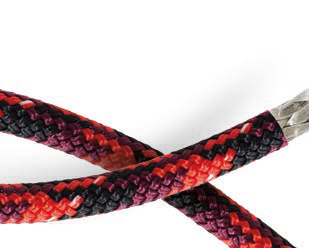
The cover is flattened or glazed where it passes through the stopper. Cover fibres are frayed or cut and the core shows through. The rope has gone hard and lost flexibility. It is visibly thinner in places or has lumps, which means a damaged core. The colour has faded to grey, a sign of UV degradation. Anchor and mooring lines have stopped stretching. And finally: you cannot remember when you bought it, bearing in mind that the indicative life of halyards and sheets in normal use is five to eight seasons.
How to extend the life
Rinse ropes after sailing in salt water, remove or ease halyards when the boat sits for long, store ropes dry and shaded, and shorten worn ends in time or end-for-end the rope so the stressed section moves.
Δεν είστε σίγουροι;
Επιλέξτε το σκάφος σας για συστάσεις διαμέτρου και μήκους, ή επικοινωνήστε μαζί μας.
Συχνές ερωτήσεις
How long a main halyard do I need?+
Twice the luff height P plus about three metres of margin. On a boat with P of 12 metres that is roughly 27 metres.
How often should halyards and sheets be replaced?+
In normal recreational use roughly every five to eight seasons, sooner at signs of cover wear or loss of flexibility. Racing boats replace more often.
Where do I find the P, E, I, J dimensions of my boat?+
In the boat documentation, from your sailmaker, or in our Boat selector, which has them for more than four thousand models and works out the rope lengths directly.